
How Much Does an Inspection Actually Cost? The Method for Calculating Your ROI
A municipality or contractor budgeting an inspection program rarely asks the right question. The instinct is to compare the purchase price of one camera to another. But equipment price says almost nothing about what an inspection actually costs in the field once you add up time, labor, safety measures, and the number of inspections a team can complete in a day.
What matters is the cost per inspection — and that's the number that lets you compare two approaches on an equal footing, then estimate the return on investment (ROI) of switching equipment or method.
Why the purchase price doesn't tell the whole story
Two cameras with an identical purchase price can produce very different operating costs depending on:
- the number of operators required (a single person vs. a team of two or three for safety and logistics)
- the average time per inspection (setup, capture, removal, documentation)
- the number of inspections achievable per day, accounting for travel between sites
- indirect costs: training, maintenance, post-processing time
A system that lets a single technician complete twice as many inspections per day can cost more to purchase while being far cheaper to operate.
The basic formula
Calculating the cost per inspection is built in three steps.
1. Total hourly cost of the intervention
Add up the loaded salary of the operators involved, the equipment's depreciation over its useful life, and related expenses (vehicle, fuel, safety equipment).
2. Average time per inspection
Include travel time between sites, setup, the capture itself, and finalizing the report.
3. Cost per inspection
Cost per inspection = (Total hourly cost × Average time per inspection) ÷ Number of inspections completed
Worked example
Let's take a simplified scenario for a municipality that performs 300 manhole inspections per year.
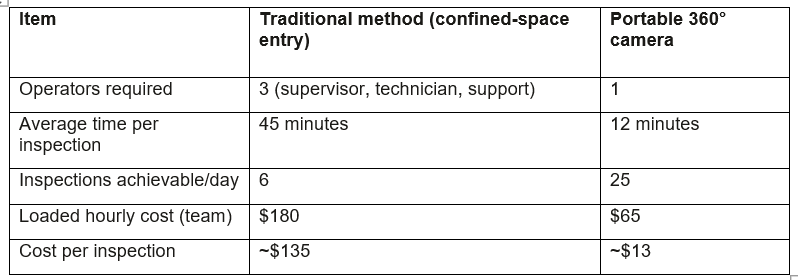
Over 300 annual inspections, that gap translates into tens of thousands of dollars in savings — before even counting the reduced risk from confined-space entry, an item that's often left out of the initial calculation but weighs heavily in insurance premiums and avoided lost-time incidents.
Why a RinnoVision camera concretely changes these numbers
The example above isn't just a theoretical exercise: each of the three items that drive down the cost per inspection corresponds to a specific feature of the RV-MAX 360 and RV-MAX 360S inspection cameras.
A single operator instead of three. The motorized 360° rotation and field-first design let one technician complete the full inspection alone, with no additional surface support crew.
Time per inspection reduced to a few minutes. Automated panoramic capture and adaptive LED lighting (up to 6,600 lumens) eliminate the manual back-and-forth of repositioning the camera or adjusting lighting.
NASSCO/MACP compliance built in from capture. Coding fields can be pre-filled directly in the software, cutting processing time once back at the office — a cost item often overlooked in ROI calculations. Learn more about how AI-powered MACP coding works.
Reduced confined-space entry risk. IP68 sealing and a design built for confined-space inspection allow for a complete assessment without an operator having to descend into the manhole.
Centralized data via RinnoCloud, which eliminates time wasted tracking down, sorting, or reformatting inspection reports scattered across multiple formats.
In other words, the ROI gain doesn't come from simply switching to a generic new method: it comes from equipment specifically designed to compress each of the cost items identified above.
What the calculation shouldn't leave out
The cost of risk. Confined-space entry involves safety protocols, standby personnel, and exposure to an accident whose cost, if it occurs, far exceeds the savings accumulated over years of conventional operation.
The value of the data. A faster inspection that produces a less detailed report isn't necessarily a saving; you need to compare inspections of equivalent quality, compliant with the same standards (MACP, PACP).
The learning curve. Inspection time decreases as teams master the tool; a calculation based on the first few weeks of use often underestimates the real medium-term gain.
Why this calculation deserves a tool, not just a formula
The formula above is simple on paper, but every organization has its own variables: local wages, network size, inspection frequency, current method. Filling out a spreadsheet by hand every time you want to compare a scenario isn't realistic for a busy manager.
That's exactly the role an interactive ROI calculator can play here: the user enters their annual number of inspections, their current method, and their average hourly cost, and gets an estimate of cost per inspection and potential one-year savings in seconds. For a visitor still weighing whether to stick with their current method or switch approaches, this kind of tool turns an informative article into concrete decision support — and gives them a legitimate reason to leave their contact information to receive a detailed estimate.
In summary
The purchase price of an inspection camera is just one variable among others. The real metric to track is the cost per inspection, which factors in labor, time, and risk. Once that baseline is established, comparing two methods — or justifying an equipment change to a municipal council — becomes a matter of numbers rather than intuition.
Calculate your own ROI
Want to know how much your organization could save by switching to a RinnoVision manhole inspection camera? Our team can put together a personalized estimate based on your annual number of inspections, your current method, and your labor cost.
Request a personalized ROI estimate →